What Is a Hydraulic System
A hydraulic system uses incompressible fluid (most often oil) under pressure to transmit force, control motion, and do work. Based on Pascal’s Law: pressure applied at one point in a confined fluid is transmitted undiminished throughout the fluid. This allows a relatively small force applied over a small area to generate a much larger force on a larger area.
Main Components
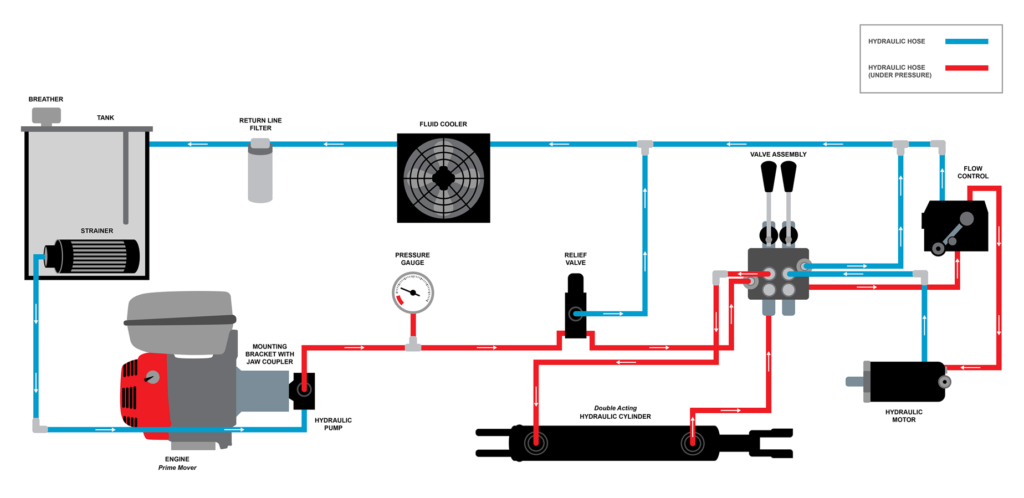
Here are the core parts of a hydraulic system, and their roles:
| Component | Function / Role |
|---|---|
| Pump | Converts mechanical energy (from a motor or engine) into hydraulic energy by pressurizing the fluid. Types include gear, vane, piston pumps. |
| Reservoir / Tank | Stores hydraulic fluid. Helps air bubbles escape, allows contaminants to drop out, helps dissipate heat. |
| Fluid | The medium for transmitting power. Needs to be incompressible, have good lubrication, temperature stability, low contamination. Usually hydraulic oil. |
| Control Valves | Direct, regulate, control flow & pressure. These include directional control valves, pressure relief valves, flow control valves. They determine where fluid goes, how fast, and with what pressure. |
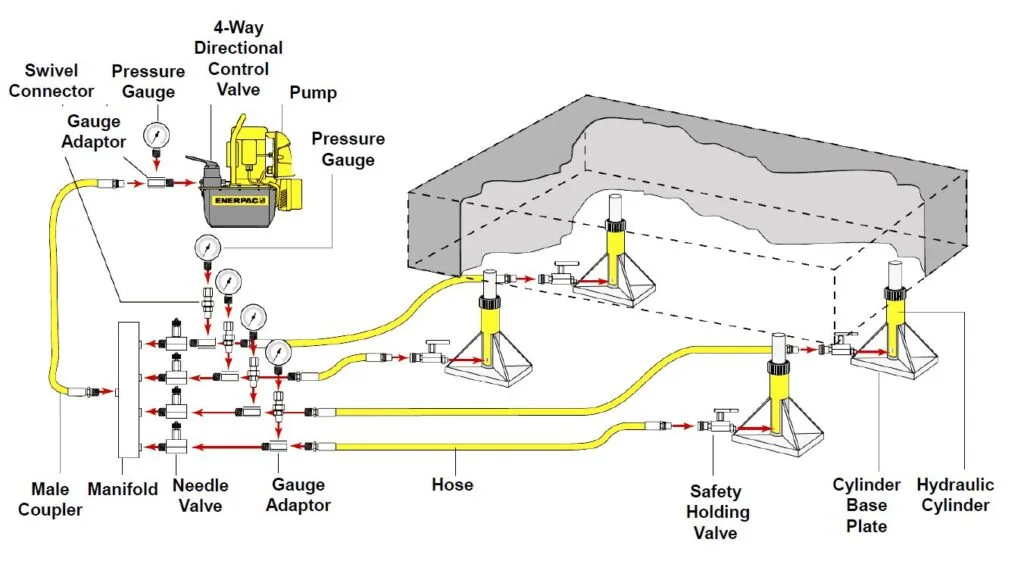
| Actuators | Convert hydraulic energy back into mechanical energy. Two major types: • Hydraulic cylinders for linear motion (lifting, pushing) • Hydraulic motors for rotary motion Types also include specialized ones (telescopic, etc.) |
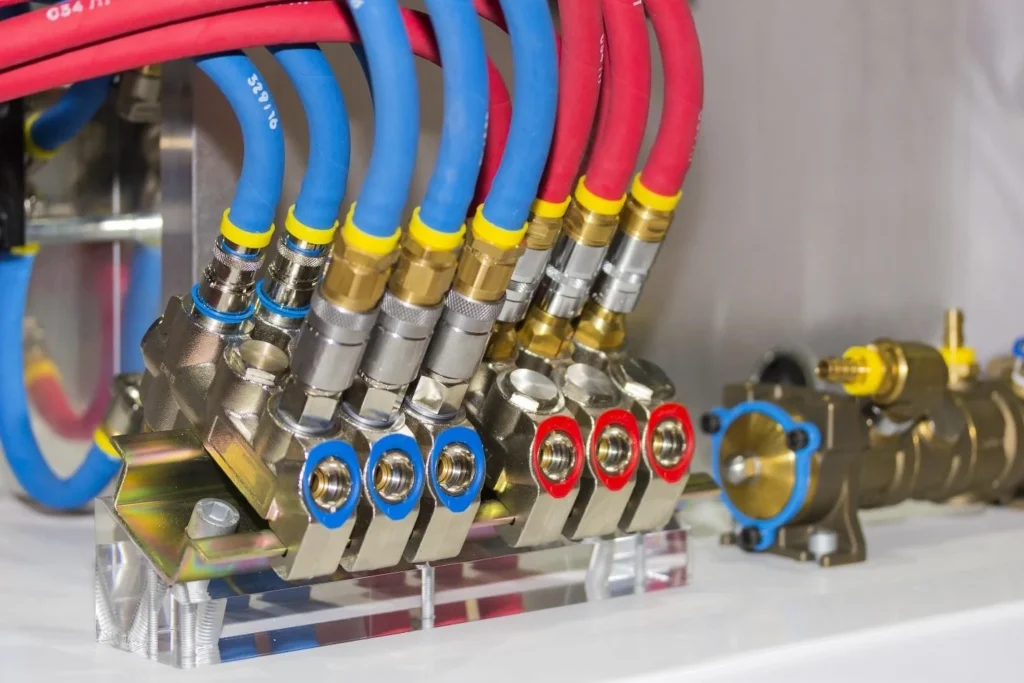
| Conductors / Lines & Fittings | Pipes, hoses, tubing, fittings that carry the fluid between components. They must withstand the pressure and avoid leaks. |
| Auxiliary / Supporting Components | Includes: filters (to remove contaminates), coolers (to manage fluid temperature), accumulators (to store fluid under pressure, absorb shocks), seals, vents, etc. |
How It Works (Basic Operation Flow)
-
Mechanical input → Pump: A motor/engine drives the pump, pulling fluid from the reservoir.
-
Pressurizing the fluid: The pump pressurizes the fluid and sends it through lines.
-
Flow control & safety: Valves control where fluid flows, how much, and relieve pressure if it gets too high (protection).
-
Actuation: Pressurized fluid is directed to actuators which do work (move a piston, rotate a motor).
-
Return / Reservoir: After passing through actuators and valves, fluid returns (often via return lines) to reservoir. Along the way it may pass through filters or coolers.
-
Maintenance of fluid quality & temperature is critical: heat generation, fluid degradation, contamination cause losses or failures.
Advantages & Limitations
| Advantages | Limitations |
|---|---|
| • Very high force in compact sizes (high power-to-size ratio). • Good precision and control of motion (speed, force) especially with directional and flow control valves. • Smooth operation even with large loads. • Reliable, especially for heavy-duty industrial, mobile, or construction machinery. |
• Requires very careful maintenance: leaks, fluid contamination, seal wear can degrade performance. • Risk of fluid heating, which reduces efficiency and can damage components. • Complex/higher cost components (pumps, valves, hoses rated for high pressure). • Fluid safety issues (fire risk, environmental concerns) depending on fluid type. |
Applications
Hydraulic systems are used in many fields, for example:
-
Construction and earthmoving equipment (excavators, loaders, cranes)
-
Industrial machinery (presses, injection molding machines)
-
Automotive systems (brakes, power steering, suspension)
-
Aircraft (landing gear, control surfaces)
-
Marine & offshore (rudders, winches, stabilizers)
-
Agriculture (tractors, planting equipment)